If you are drawn to mesmerising landscapes, then Utah is a destination that will not disappoint. From otherworldly geological formations to enchanting wildlife havens, it really feels like nature is showing off.
Known collectively as the ‘Mighty Five’, the ‘Beehive State’ boasts some of the country’s most spectacular National Parks. True to their nickname, Zion, Arches, Bryce Canyon, Capitol Reef, and Canyonlands National Parks are nothing short of magnificent. Exploring these landscapes really makes you feel small, as you are encompassed by their grandeur and majesty.
Many of Utah’s iconic vistas are characterised by captivating red rock formations, but the state offers incredible diversity. The hoodoos of Bryce Canyon and towering red cliffs of Zion rightly demand attention but venture outside of Utah’s ‘Mighty 5’ National Parks and you’ll discover so much more.
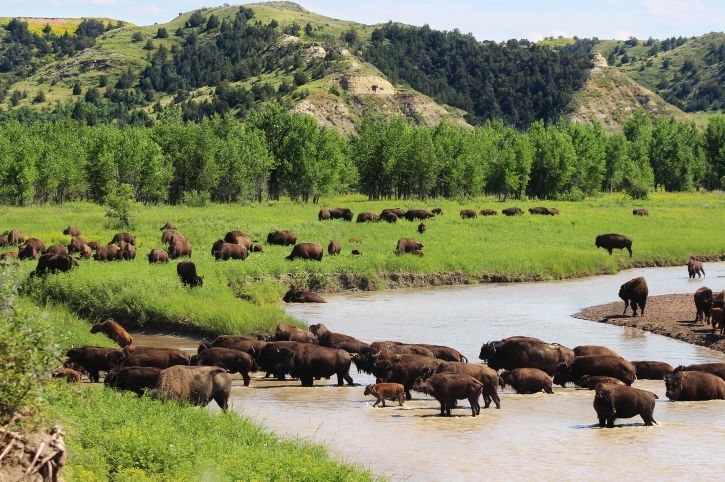
On Antelope Island, bison, coyotes, and big horn sheep roam free. At the Bonneville Salt Flats, a shimmering white plain stretches out in front of you, with only the mountains on the horizon to provide perspective. In the Wasatch Mountains you’ll discover stunning wildflower meadows, alpine lakes, and rugged peaks.
Admire ten of the best views in Utah below, as we introduce you to each of these incredible landscapes.

Where the Mojave Desert, the Colorado Plateau, and the Great Basin all converge, you’ll find Zion National Park. This incredible landscape is a geographic phenomenon. What was once a nearly flat basin was built up over millions of years as the area was covered by oceans, rivers and desert, leaving behind layers of sand and mud that hardened into rock. Tectonic forces then pushed the ground up, creating a high plateau, which was carved out by the Virgin River, creating the dramatic canyons you can see today.
Although most visitors come for views of the thousand-foot deep, red rock Zion Canyon, you can also admire slot canyons, monoliths, waterfalls and hanging gardens, where spring-fed plant ecosystems bloom up sandstone walls.
You can easily spend days exploring the park’s extensive trail network, with paved trails suitable for beginners, up to challenging multi-day hikes. To admire the view from ‘Angels Landings’, as pictured here, it takes a strenuous hike, but the scenery is well worth it. It is a picture of magnificent colours: the striking red cliffs and pockets of lush greenery are framed by a piercing blue sky.

The Wasatch Mountain Range offers an iconic backdrop to Salt Lake City, with the range stretching 160 miles from Utah’s northern border with Idaho into the centre of the state. Part of the Rocky Mountains, the Wasatch Mountains are characterised by sharp mountain ridges, active fault lines and seven steep canyons that feed into the Salt Lake Valley.
Salt Lake City’s ‘backyard playground’ lends itself perfectly to outdoor activities year round. Summer is all about hiking, biking, kayaking and climbing, and in winter, don your skis.
Spectacular views like these are easily accessible. You can hike the foothills of the Wasatch Mountains from Salt Lake City: follow the 2.7-mile Living Room Trail from the Natural History Museum of Utah to a summit that has sandstone ‘furniture’, offering a place to rest your legs whilst admiring panoramic vistas of the valley. Alternatively, ride the Snowbird Aerial Tram to the top of Hidden Peak to admire the Wasatch Mountains in all their glory.

Canyonlands National Park feels wild and remote. Stretching across 527 square miles, this fascinating landscape is made up of a sprawling network of deep canyons and towering mesas, formed by the currents and tributaries of the Green and Colorado Rivers over the last 20 million years.
For one of the park’s most iconic vistas, hike up to the stunning Mesa Arch viewpoint. The trail is a relatively accessible 0.6 mile out-and-back, and it is especially spectacular at sunrise. Through the 27-foot arch you can see for miles, looking over to Buck Canyon and the La Sal Mountains in the distance. Alternatively, get the opposite perspective, gazing up at the sheer cliffs, on a rafting tour. You can opt for a thrilling white water adventure, or simply take in the beauty and solace of the park on a guided float.
Pictured here are the unique ‘Needles’ formations, found in the quieter southeast corner of Canyonlands National Park. These colourful spires of Cedar Mesa Sandstone tower above you, and you’ll find intricate rock art hidden amongst them.

Sitting on the border between Colorado and Utah, this 25 mile canyon gets its name from the ruby-red sandstone cliffs that line its walls. Only accessible by rail or on a rafting adventure, access to these striking views feels wonderfully exclusive.
The most leisurely way to see the jaw-dropping, red sandstone cliffs of Ruby Canyon is on board the newly launched Canyon Spirit, a luxury rail experience travelling from Denver to Salt Lake City, following the Colorado River as the landscape transitions from the Rockies to the iconic red rocks of Utah. Alternatively, climb aboard Amtrack’s California Zephyr, taking a cross-country journey all the way from Chicago to San Francisco, via Denver and Salt Lake City.
For the more adventurous, opt for a river raft through the gorge. There are ample opportunities for side hikes too, as you navigate its twists and turns.

Situated just outside of Moab, the 73,000-acre Arches National Park is a photographer’s dream, with its namesake arches beautifully framing its soaring sandstone towers and precarious-looking pinnacles.
Delicate Arch, pictured here, is one of the region’s most iconic viewpoints. Standing at 46 feet high, and 32 feet wide, it is the largest free-standing arch amongst the 2,000-odd stone arches found in the National Park, almost seeming to defy gravity. It’s a moderate 5km round trip to reach this spot, but you’ll be treated to awe-inspiring scenery along the trail. Formations including Tower Arch, Double O Arch and Broken Arch are similarly spectacular.
To admire these impressive formations for yourself, Arches National Park boasts an abundance of hiking trails, suitable for a range of abilities.

Offering a dramatic contrast to Utah’s vivid red rock landscapes, Antelope Island is a unique habitat, with white sand beaches, rolling hills and dry grasslands.
Surrounded by The Great Salt Lake, it’s not the first place you would expect to find wildlife. However, the 40 freshwater springs on Antelope Island help sustain a healthy herd of over 500 bison, as well as free-roaming bighorn sheep, mule deer and pronghorn antelope (that can run at 70 miles per hour!).
Each October, in a quite thrilling spectacle, the bison are rounded up by a couple of hundred cowboys and girls to be checked over by a vet, with visitors able watch from designated viewing points. During the autumn and spring, Antelope Island is also home to thousands of migratory birds, as they stop to feast on brine shrimp along the Great Salt Lake’s shore.
The island can only be accessed via a 7-mile causeway, around 30 miles north of Salt Lake City. Stay to admire the sunset from Buffalo Point, followed by a night sky full of stars.

Much of Bryce Canyon National Park is actually an alpine forest, although the trees are outnumbered by striking red rock hoodoos. Formed by millions of years of freezing and thawing, these fascinating formations cast captivating hues of oranges, reds and whites throughout the park.
For the best views, anywhere along the rim of the Bryce Canyon Ampitheatre is spectacular, looking down over the vast horseshoe-shaped bowl dotted with hoodoos. There are four main viewpoints: Sunrise Point, Sunset Point, Inspiration Point and Bryce Point.
It is well worth getting up early and heading to ‘Sunrise Point’, to watch as the park’s fascinating rock formations are lit up in a mesmerising glow, and to spot the mule deer that graze peacefully on the plateau. Despite the name, however, you can see the rock formations in fantastic light at any time of day from this spot.

18,000 years ago, Lake Bonneville was one of the largest lakes in the Great Basin of western North America. Mammoth and giant ground sloth wondered its shores. But then the water disappeared. First in the Bonneville Flood, and then through evaporation, leaving a crystalised crust of concentrated minerals, five feet thick in places, and almost inhospitable to life!
A trip to the Bonneville Salt Flats today is an otherworldly experience. It really is like no where else on earth. A vast, dazzling white plain stretches out before you, and crunches under foot.
As well as the beautiful views, the Bonneville Salt Flats are an international hub for car racing. In fact, several racing records have been set here, with the fasted land-speed record of 630mph established in 1970. Today, there are three annual speed events that you can get involved with, or simply go to admire the landscape.

Even with the state’s wealth of impressive views, it is difficult to compete with Capitol Reef’s expansive, seemingly endless vistas, punctiated by colourful, rugged rock formations. The park’s landscapes feel as though they belong to another planet, and, if you’re lucky, you’ll get to enjoy some of its most striking formations all to yourself.
The landscape of Capitol Reef National Park is defined by the Waterpocket Fold, a wrinkle in the Earth’s crust that stretches for almost 100 miles. Along the fold, rocks have been forced upwards and erosion has sliced dramatically through the layers, creating narrow canyons, capitol-like domes and sheer cliffs.
The park’s miles of hiking trails are the perfect way to escape and enjoy some peace and quiet. For a leisurely stroll, take one of several beginner routes with trailheads along Highway 24 or the Scenic Drive. More challenging walks will take you through striking slot canyons.

Located along the San Rafael Reef, this fascinating landscape is often compared to Mars. Aptly named, Goblin Valley State Park is famous for its Entrada Sandstone hoodoos which resemble goblin-like figures, or mushrooms. This extraordinary landscape has been sculpted by 170 million years’ worth of erosion of the soft sandstone.
Goblin Valley’s 15 square miles are like a natural maze, and unlike many parks that have strict trails, you are encouraged to climb and walk freely amongst these fascinating formations. You can spend a couple of hours simply getting lost, wandering between the ‘mushroom’ rocks in your own mystical playground.
As well as exploring the slot canyons and bizarre formations up close on foot, you can mountain bike in the park too. Designated as an International Dark Sky Park, it is also one of the best places in the country for stargazing.
Utah is an easily accessible destination from the UK, with several direct flights from London Heathrow to Salt Lake City each week. Alternatively, Las Vegas or Denver act as a great starting point for exploring Utah’s National Parks and stunning scenery, by car, motorhome or escorted tour.
Although Utah is a year-round destination, with a huge winter sports scene, spring makes a great time of year to see these views in all their glory. Utah can get extremely hot in the summer, and you can expect bigger crowds at some of the National Parks. March to May is the shoulder season, but it is perfect weather for hiking and outdoor activities, as temperatures sit between 7°C and 16°C and the days are getting longer.
If you’re ready to plan your Utah holiday, just get in touch with our America Experts, and they’d be delighted to help you create your perfect itinerary.
Explore Utah on these recommended itineraries, or get in touch to create your own.


Las Vegas | Grand Canyon | Lake Powell | Monument Valley | Mesa Verde | Canyonlands | Bryce Canyon | Mesquite


Salt Lake City | Zion National Park | Bryce Canyon | Capitol Reef | Canyonlands | Arches | Park CIty


Las Vegas | Grand Canyon | Lake Powell | Monument Valley | Mesa Verde | Durango | Arches | Bryce Canyon | Zion National Park
Las Vegas | Grand Canyon | Lake Powell | Monument Valley | Mesa Verde | Canyonlands | Bryce Canyon | Mesquite
Salt Lake City | Zion National Park | Bryce Canyon | Capitol Reef | Canyonlands | Arches | Park CIty
Las Vegas | Grand Canyon | Lake Powell | Monument Valley | Mesa Verde | Durango | Arches | Bryce Canyon | Zion National Park
Grace joined the Marketing Team at Freedom Destinations after she returned from three months backpacking around Australia. Her long-haul travels have also taken her to Canada, the U.S. and South East Asia so far, but her destination wish list is far from complete!